
Interoception and Autism - lessons for rehab and wellbeing
Interoception is in vogue these days. And it’s about time I think. You wouldn’t be too capable travelling through a new place without a good map, and yet we tell people with chronic pain and illness to do all manner of things equivalent to ‘driving blind’ without prioritising the skill and process of listening to their body. And that’s exactly what Interoception is trying to describe. It’s a call all term defined as the perception of afferent neural signals from organs, tissues, and physiological processes by the central nervous system.
Because Interoception covers such a broad array of subjective experience, three key dimensions of Interoception have emerged within the scientific literature:
Interoceptive Sensibility (IS): The self-assessment of how intensely bodily sensations are perceived compared to others.
Interoceptive Accuracy (IA): A metric measure of how accurately individuals can perceive interoceptive signals, such as through heartbeat tracking or discrimination tasks.
Interoceptive Awareness (IAW): The agreement between measured accuracy and self-assessed assurance in that ability.
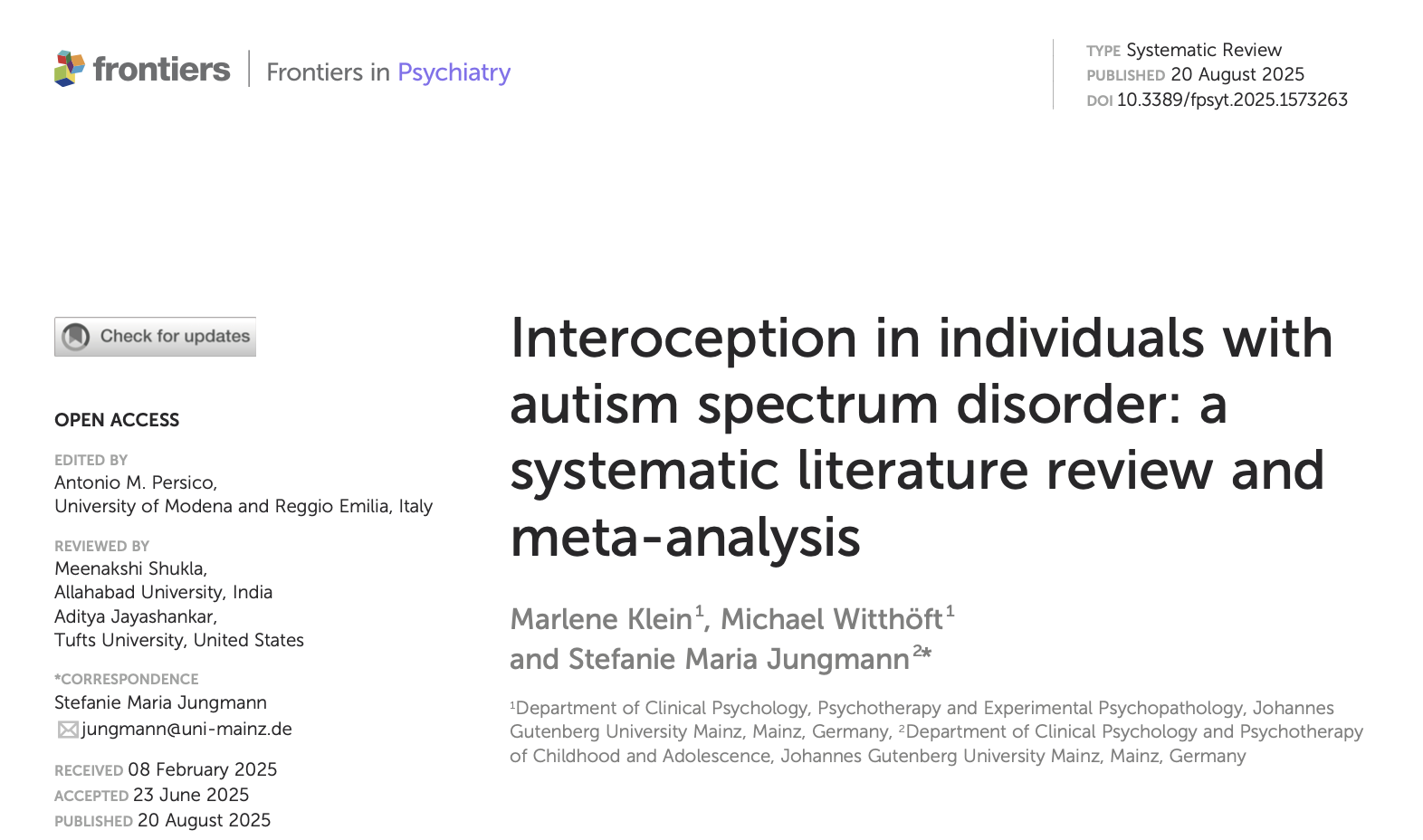
The research paper we are reviewing today explored the existing literature on interoception in individuals with Autism. This caught my eye as being relevant for pain care, as I myself am neurodivergent, and I find myself focusing on interoception with clients more than anything else these days. Because our capacity to listen to our body is ground zero for determining what the best next action might be - e.g. to rest, or to move?
The review and meta-analysis focused on interoception in Autistic adults particularly because of their hypo/hypersensitivity to sensory aspects of the environment and alterations in emotion recognition and processing.
What did they find?
The authors found no significant difference in interoceptive accuracy between adults with Autism and neurotypical controls when completing the heartbeat detection task.
Results for children and adolescents were more varied, with some studies reporting reduced, increased, or similar interoceptive abilities compared to neurotypical controls.
In areas of interoceptive sensibility (how intense interoceptive experience is compared to others) and awareness (how accurate someone’s interoception is compared to objective measurement), results were inconsistent across all age groups of Autistic participants when compared to neurotypical controls.
Brain imaging studies show altered functional connectivity in regions like the insular cortex and thalamus in Autistic people, which are crucial for interoceptive and emotional integration.
The authors highlighted significant methodological challenges contributing to inconsistent findings, including: diverse measurement instruments, age ranges, and analytical approaches. And therefore advocated for more standardized methodologies and age-appropriate linguistic adaptations of tests and questionnaires, alongside longitudinal research, to clarify developmental trajectories.
What do these findings tell us?
The diverse findings in interoceptive measures had differing interpretations beyond the challenges of measurement methods.
Many Autistic people experience difficulties with language, communication and interpersonal interaction more broadly. The authors posited that perhaps there is more difficulty in the interpretation of bodily sensations in certain contexts rather than reduced interoceptive sensibility itself. This was seen in results of altered insular cortex activity in across different experiments.
They also posited that higher symptom burden could result in a lower ability to detect interoceptive bodily signals.
While adult cardiac interoceptive accuracy appears largely intact, the broader association between Autism and interoception remains complex and requires further clarification, particularly in younger populations. We need better measurement validity and standardisation to advance our understanding.
My personal assertion is that interoceptive capacity is likely contextual according to the degree of support and safety the autistic person is receiving, rather than some concrete unchanging phenomena. And that much research on Autism and other divergent neurotypes is limited by a significant amount of un-acknowledged pathologising and prejudiced assumptions.
We still have a long way to go in terms of understanding and measuring interoception, but I hope that as we go along we can use less pathologising, more context-based systems to empower each of us to understand our body, find safety and wellbeing more easily.
REFERENCE:
Klein, M., Witthöft, M., & Jungmann, S. M. (2025). Interoception in Individuals with Autism Spectrum Disorders-A Systematic Literature Review and Meta-Analysis. Frontiers in Psychiatry, 16, 1573263.